Unfortunately, when all was said and done, our mousetrap car was not victorious. However, we paid attention to how physics affected our car, so we can give an account of how what we've learned this year figured into our car.
The most obvious was Newton's laws of motion. The first law, that an object in motion would stay in motion in a straight line unless interfered with, was important for designing our steering. We knew that if our car turned, the steering was off. This allowed us to align our wheels as straight as possible. The second law, that acceleration is the net force divided by the mass, allowed us to figure out how to get a faster car. By reducing the mass and increasing the acceleration, we made our car have slightly more force than it did previously. The third law, that every action has an equal and opposite reaction, meant that we had to figure out how to direct the backwards force. The lever pushed the car forward, but the wheels pushed backwards against the floor. This propelled the car forward.
The friction of the floor against the wheels was both a boon and a hindrance. It pushed the car forward, but too much meant that we had a slow car, and we did not win. The friction used up energy from the mousetrap and acted on the car in the backwards direction.
We chose to use CDs for wheels, as they have a larger tangential velocity than a small wheel with the same rotational velocity. This allowed the car to move faster than with a small wheel. Originally, we planned to use 45s, but the difficulty in procuring them, plus the potential difficulty in securing them to the axle, caused us to scrap that plan. We also powered our car with the same plan. The tangential velocity of the skewer on the trap was higher than that of the trap itself, meaning more momentum and acceleration for the skewer.
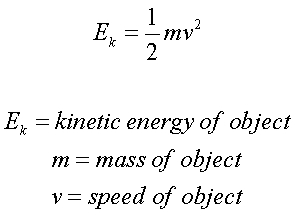
The law of conservation of energy says that energy is never created or destroyed, just transferred. We used the skewer attached to the trap to impart a lot of energy to the wheels. Kinetic energy equals 1/2 mass times the velocity squared, so if the skewer had high velocity, the car would have lots of energy.
Our lever arm was a skewer. It was about 10 inches long. This, times the force of our car, meant that the torque was higher than the torque if we hadn't used a skewer. there, the lever arm would only be a few inches.
While the rotational velocity of our wheels was high, so was the rotational inertia. This meant a slow start, and therefore, low acceleration. we were unable to fully overcome this problem. Thus, our car did not move when it wax propelled. This was unfortunate.
We do not know how much work the car did. While we know how far it traveled, and we could determine the mass of the car, we don't know its acceleration. Thus we cannot determine the force, and therefore cannot determine work.
The general design of our car was the same as it was at the start, with some changes. Most notably, we replaced cotton balls in our plans with rolled-up paper towels. We also used a skewer instead of a pencil for a lever arm, and used a rubber band to connect the back axle and the end of the lever arm skewer. Mostly, though, the plan was unchanged.
We encountered a problem propelling our car. We could not get it to go, so we were unable to do a run. Thus, we were not victorious. This is still unfortunate.
If we were to do this project again, I would choose to develop a better way of propelling our car. Everything else worked fine. The wheels rolled, it went mostly straight, and the car stayed together. We just couldn't propel it.