This unit, we learned about multiple aspects of physics. The most important parts were the work-energy theorem, relationship between kinetic and potential energy, and the mechanics of work, kinetic energy, and potential energy.
We learned that work equals force times distance.

If a person pushes on a wall, he does no work because the wall does not move. If he carries a book, he does no work on the book because the force and distance vectors are perpendicular.
The work-energy theorem states that the change in energy equals work.

If we know the work and initial or final energy of an object, we can calculate the total energy of the object.
Kinetic and potential energy are inversely related. If one goes up, the other goes down by the same amount.

If an object's total energy is 10,000, and it's not moving, it has 10,000 joules of potential energy. If it has 5,000 joules of potential energy, it has 5,000 joules of kinetic energy.
An object's kinetic energy is calculated using this formula:
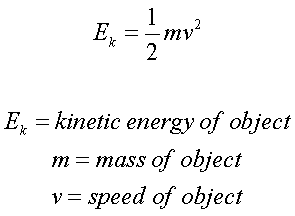
If an object's speed is doubled, its kinetic energy is quadrupled. If an object's speed is halved, it has one quarter of its original kinetic energy.
An object's potential energy is calculated using the following formula:

This also shows the work-energy theorem. If an object's mass and acceleration due to gravity are the same, but one has more potential energy, that one has more height. If one's potential energy is higher, but they have the same height and acceleration due to gravity, the one with more energy has more mass.

No comments:
Post a Comment