We studied Coulomb's Law in order to determine the charge of objects. Coulomb's Law states that the force of attraction or repulsion between two charged particles equals the constant k times the charge of the first particle (q1) times the charge of the second particle (q2), divided by the square of the radius between the two particle's centers.
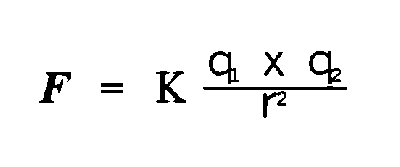
If two particles each have a charge of 3 coulombs, and the radius of a circle placed in between them is 2, then they will repulse each other with an initial force of 3*3k/2^2=9k/4=2.25k newtons, with the force deceasing as the radius of the circle between them increases. K here is a number derived using calculations involving the speed of light and various Greek letters, and will not be discussed here.
Electric potential is the electric potential energy of an object divided by the charge of the electric field the object is in. Electric potential is measured in volts. Mainly, we used electric potential to determine the current of an object using Ohm's Law.
Ohm's Law is a formula that states that the current that flows through an object equals the voltage of the object, divided by the object's resistance. It is usually represented as I=V/R, where R is usually replaced with the Greek letter omega.

This is an omega.
Ohm's Law allows us to determine how much current is flowing through an object, which allows us to determine whether an appliance, such as a hairdryer, will operate sub-optimally, at full power, or overload and malfunction.
There are two types of circuits: parallel and series.
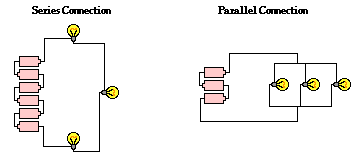
In the series connection, each object that draws power is connected in succession, while in the parallel circuit, each lightbulb is connected individually to the power source. In a series connection, each light must draw power from the same pool as the other two, which increases the resistance. This means that one must have a much higher electric potential to get full use from each light, as Ohm's Law states that as resistance increases, voltage must increase to give the same current. This essentially is adding traffic lights to the wire, slowing the current. The parallel circuit has multiple wires, allowing each light to light independently of the others. This decreases the resistance without decreasing the voltage, which Ohm's Law states will increase the current. This is like adding more lanes for cars on a road, allowing more cars to pass through the same road. Additionally, because all the bulbs in a series circuit are connected, if ones goes out, they all go out. This is not true for parallel circuits, where bulbs will remain independently lit.
There are several different types of charging an object. One way is friction charging. This involves rubbing an object against another object, causing one to take electrons from the other. This causes the giving object to become positive, and the taking object to become negative.

The balloon steals electrons from the woman's hair, causing it to become positively charged.
Another way is induction. An already-charged object is held close to an uncharged object, causing the uncharged object to polarize, meaning it becomes positive on one side and negative on the other. Capacitors charge and clouds create lightning this way.

Lightning, how induced charge between the earth and the clouds is dissipated.
We also covered electrical resistance. Resistance is measured in ohms. The symbol for an ohm is the omega, seen above. The resistance of an object is calculated by dividing the voltage of an object by the current flowing through the object. The result is the amount, in ohms, of resistance inherent in that object.

Jared,
ReplyDeleteYou did a good job including the concepts we learned about in this unit. Your pictures are nice!
A few of your statements are confusing:
* We used Coulomb's law to determine the effect of distance between charges on the force between those charges.
* We talked about the electric potential difference causing current and thus relating it to Ohm's law
* I am not sure I understand what you mean about "This means that one must have a much higher electric potential to get full use from each light"
* Polarization is not a way to charge an object. The object remains neutral because there is an even amount of positive and negative charges.
I also didn't see any commentary about what you found challenging in this unit, how you overcame it, and how your problem solving skills improved. I will look forward to reading about them in your next blog.
That was a nice post, I really like your pictures! I have pictures on my blog too. Next time I would pay more attention to the details when explaining what we learn and maybe add some videos. Overall great work!
ReplyDelete