In this chapter, we discussed how magnets work.

Magnets have magnetic fields because of poles. They have poles because of how its domains are aligned. If a magnet's domains are aligned, the magnetic field will go from "South" to "North" inside the magnet, and from North to South outside the magnet.

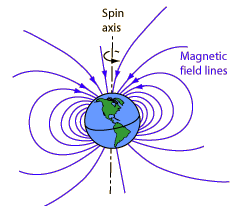
The Earth's magnetic field works because the core of the Earth is solid iron, causing a large magnetic field around the Earth.
Electromagnets work by running an electrical current through a piece of metal. Normally, this metal is unmagnetized. However, running a current through it allows it to become a very strong magnet, as seen here.
 The current causes a fluctuation in the magnetic field, causing the domains to become temporarily aligned and making the magnet very strong.
The opposite is true as well. If a magnet is ran through or past an object that is also magnetic, the object will have a small voltage induced in it, which in turn will induce a voltage, allowing the wire to power an object.

As seen in the picture, the magnet must move to induce a voltage. If it does not, it will not cause anything to happen.
Generators use a similar process to create power. A person or machine turns a crank which is connected to a magnet with a coil of wire wrapped around it. This magnet and coil is near another magnet. When the crank is turned, the magnet and coil spin. This causes fluctuations in the magnets' magnetic fields, which causes a fluctuation in the wire's magnetic field. This induces a voltage in the wire, which in turn induces a current in the wire. This creates power, which allows the generator to power objects that need it.
Motors and transformers work in reverse of this. The coil of wire is near a magnet, and has current run through it. In the motor, this causes the coil to spin, as it is made to only receive current at certain times to allow it to spin. In the transformer, the coil is near another coil. The first, or primary, coil is wrapped a certain number of times around an object. The second, or secondary, coil is wrapped a different number of times. If it is wrapped more than the primary coil, it is a step-up transformer. If it is wrapped less than the primary coil, it is a step-down transformer. The primary and secondary coils are placed close to each other, and current is run through the primary. This causes a fluctuation in the secondary coil, which causes it to receive a voltage different from the primary coil's voltage, which induces a current different from the primary coil's current. However, the primary's current multiplied by the primary's voltage equals the secondary's current times the secondary's voltage. This process allows an object to receive more or less voltage or current if it needs it. This prevents a 12 V laptop from frying from power taken from a 120 V outlet.
A video of transformers and generators can be seen here.
This unit was not too difficult for me. I found that it built on the last unit quite naturally, and used what I learned there in this section. While my knowledge of the workings of these concepts improved, I felt that it made more sense coming after the last unit than any other two sequential concepts this year.

Good Job Jared! This Blog was very through and covered everything we learned. I especially liked your paragraph on electromagnets and the picture you showed. That picture really demonstrates the magnetic field lines well. I also like how you included the podcast to provide more information on the unit. I also agree with you when you say this unit built on the last one naturally. Good examples and Good job!
ReplyDelete