10. Inertia
Inertia, as defined in Newton's First Law, is a concept that states that an object will continue in its current path at a constant velocity, or remain at rest, unless acted on by an outside force. This means that without someone kicking it, a rock will always remain on a sidewalk. When someone kicks it, the rock will continue in the same direction at the same speed until something slows it down, speeds it up, or changes its path.
9. Friction
Friction is a force that occurs when two objects interact. When our rock rolls along the ground, it is constantly interacting with the ground, which induces a a push in the direction opposite of the rock's direction of travel. This push is known as friction.
8. Conservation of energy
The conservation of energy in the physical world means that energy cannot ever be created or destroyed, only have its form changed. When our rock rubs up against the ground, it experiences friction. This friction causes the rock to lose some of its initial energy, and give it to the ground. Some of the energy, does not go into the ground, and it is given off as light and heat. This might not noticeably warm the rock or the ground. It might not give off any visible light either. However, it is there.
7. Potential energy
Potential energy is an object's energy respective to its surroundings. If the rock were on the edge of a cliff, it would have a high potential energy, as it could fall off the cliff and create kinetic energy. f it fell off this cliff, after 10 meters it would have less potential energy, as it would not be as high up. If it had a mass of 50 grams and a height of 100 meters, it would have a potential energy of 49 000 joules at the top because potential energy equals mass times the acceleration of the object times the object's distance from the ground.
6. Kinetic energy
Kinetic energy is the energy of motion. An object's kinetic motion can be determined by squaring its velocity, multiplying that by its mass, then dividing that number by 2. I an object isn't moving, its kinetic energy is zero. If the rock was dropped off the cliff, it would have a kinetic energy of 24 500 joules after 50 meters. This is because the potential energy plus the kinetic energy of an object always equals the initial total energy of the object, as long as it has not stopped.
5. Gravity
Gravity is a very weak force, being many times weaker than the next weakest fundamental interaction, the weak nuclear force. However, it is the only one of the four that has an impact on our everyday lives. Gravity keeps us secured to the Earth because the Earth is very large compared to us, and we are close to its center. The equation for gravitation is g equals the product of the two masses of the two interacting objects times the universal gravitational constant, or G, divided by the square of the radius between the two objects. The g for Earth is approximately 9.8 meters per second squared.
4. Longitudinal waves
Longitudinal waves are waves that travel in a certain direction, or appear to do so. The frequency of the waves going one way is different from the frequency of the waves going the other way. This seems to us as if the waves travel in one direction or the other.
3. Standing waves
Standing waves are waves that do not appear to travel, but simply oscillate. This happens because the waves going one way have the same frequency as the waves going the other way, but in the opposite direction. Thus, they appear to go up and down in place, instead of traveling as longitudinal waves do.
2. Bernoulli's principle
Bernoulli's principle states that as a fluid's pressure increases, its velocity decreases, and vice versa. This can be observed in a soda bottle. If the bottle is under pressure because it has been shaken, it will travel very fast if it blows the cap off, then will slow down as its pressure is relieved.
1. Coanda effect
The Coanda effect states that fluids that travel over a curved surface will tend to conform to the curve of the surface. This helps airplanes generate lift. The air goes over the curved surface, increasing its velocity in order to get close, but not to the same point as, the air that goes under the wing. The increase in velocity of the air that goes over the wing causes its pressure to drop due to the Bernoulli principle. The pressure difference between the bottom and top of the wing pushes the wing up, giving the plane lift.
Tuesday, May 15, 2012

Revision of photo project

This photo demonstrates both Newton’s Second Law and
Newton’s Third Law. Newton’s Second Law states that force equals the mass of an
object times its acceleration. The mass of the object may vary, but the
acceleration at a certain point will always be constant, ~9.8 meters per second
per second on Earth. It also displays Newton’s Third Law. While the earth’s
gravity pulls on the hat, with an acceleration of ~9.8
m/s^2, the hat also pulls on the Earth. The acceleration due to gravity on the
Earth from the hat is equal to the hat’s mass times the universal gravitational
constant, ~6.67 times 10 to the -11th Newton-meters squared over kilograms
squared, over the radius of the circle with a diameter the length of the
distance between the Earth’s center and the hat’s center. The hat will have all
of these variables equal to the Earth’s, with the exception of mass. The hat’s
mass is much smaller, so it will cause less acceleration due to gravity on the
Earth than the Earth causes on the hat. Thus, the hat will fall to the ground,
while the Earth will barely budge from its orbit.
Tuesday, May 8, 2012
Electricity and Magnets
In this chapter, we studied magnets and their effect on electricity. We discussed how magnets work, how the Earth's magnetic field is created, how magnets have poles, how electromagnets work, how magnets affect electrical fields, and how this can be used to power objects.
 In a magnetized object, the domains of an object, the spin of its atoms, become aligned. The domains of a magnet determine the poles of the magnet are aligned. How aligned the domains are affects the strength of the magnet. If a person were to stick a paper clip to a magnet, that paper clip would be less magnetized than a neodymium supermagnet. The domains of an object can be aligned in several ways. One is shock. Aligning a piece of potentially magnetic metal with a magnetic field and striking it will cause some of the atoms to become aligned with the magnetic field. Another way is constant magnetization. If a strong magnet is constantly left near an unmagnetized magnet, the unmagnetized object will become magnetized in the same way as the strong magnet over time. Because of this, shipboard magnets are specially calibrated to avoid being attracted to the ship, and strong magnets must be kept away from some equipment that relies on magnets, such as computers and pacemakers. Only three metals, and compounds containing these metals, can be magnetized. These are iron, nickel, and cobalt. Other objects cannot be magnetized.
 The names North and South come from the Earth's magnetic field, as that is how the charges flow there. Thus, it became the custom to call the directions North and South. Different poles of a magnet will attract each other, and like poles will repel each other. Compasses work because they align to the Earth's magnetic field. The South pole of the needle will be attracted to the magnetic North of the Earth, while the North Pole of the needle will be attracted to the magnetic South pole of the Earth. Magnetic fields are strongest when they are perpendicular, because they are able to block the object fully and slap it aside. The field is weakest at the poles, because the field cannot block the object, and allows to pass.
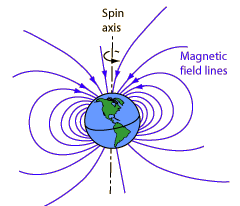
The Earth's magnetic field works because the core of the Earth is solid iron, causing a large magnetic field around the Earth.
 This magnetic field is important because it repels cosmic rays which cause cancer. At the Equator, the field slaps the rays aside, preventing them from getting to the surface. At the poles, the field cannot block the rays, which are visible as the aurora borealis and aurora australis. However, this means that a person at the North pole has a higher chance of getting cancer than a person at the Equator.
Electromagnets work by running an electrical current through a piece of metal. Normally, this metal is unmagnetized. However, running a current through it allows it to become a very strong magnet, as seen here.
 The current causes a fluctuation in the magnetic field, causing the domains to become temporarily aligned and making the magnet very strong.

In this chapter, we discussed how magnets work.

Magnets have magnetic fields because of poles. They have poles because of how its domains are aligned. If a magnet's domains are aligned, the magnetic field will go from "South" to "North" inside the magnet, and from North to South outside the magnet.

The Earth's magnetic field works because the core of the Earth is solid iron, causing a large magnetic field around the Earth.
Electromagnets work by running an electrical current through a piece of metal. Normally, this metal is unmagnetized. However, running a current through it allows it to become a very strong magnet, as seen here.
 The current causes a fluctuation in the magnetic field, causing the domains to become temporarily aligned and making the magnet very strong.
The opposite is true as well. If a magnet is ran through or past an object that is also magnetic, the object will have a small voltage induced in it, which in turn will induce a voltage, allowing the wire to power an object.

As seen in the picture, the magnet must move to induce a voltage. If it does not, it will not cause anything to happen.
Generators use a similar process to create power. A person or machine turns a crank which is connected to a magnet with a coil of wire wrapped around it. This magnet and coil is near another magnet. When the crank is turned, the magnet and coil spin. This causes fluctuations in the magnets' magnetic fields, which causes a fluctuation in the wire's magnetic field. This induces a voltage in the wire, which in turn induces a current in the wire. This creates power, which allows the generator to power objects that need it.
Motors and transformers work in reverse of this. The coil of wire is near a magnet, and has current run through it. In the motor, this causes the coil to spin, as it is made to only receive current at certain times to allow it to spin. In the transformer, the coil is near another coil. The first, or primary, coil is wrapped a certain number of times around an object. The second, or secondary, coil is wrapped a different number of times. If it is wrapped more than the primary coil, it is a step-up transformer. If it is wrapped less than the primary coil, it is a step-down transformer. The primary and secondary coils are placed close to each other, and current is run through the primary. This causes a fluctuation in the secondary coil, which causes it to receive a voltage different from the primary coil's voltage, which induces a current different from the primary coil's current. However, the primary's current multiplied by the primary's voltage equals the secondary's current times the secondary's voltage. This process allows an object to receive more or less voltage or current if it needs it. This prevents a 12 V laptop from frying from power taken from a 120 V outlet.
A video of transformers and generators can be seen here.
This unit was not too difficult for me. I found that it built on the last unit quite naturally, and used what I learned there in this section. While my knowledge of the workings of these concepts improved, I felt that it made more sense coming after the last unit than any other two sequential concepts this year.
Photo Project

This photo demonstrates both Newton’s Second Law and
Newton’s Third Law. Newton’s Second Law states that force equals the mass of an
object times its acceleration. The mass of the object may vary, but the
acceleration at a certain point will always be constant, ~9.8 meters per second
per second on Earth. It also displays Newton’s Third Law. While the earth
obviously pulls on the hat, with an acceleration of ~9.8 m/s^2, the hat also
pulls on the Earth. The acceleration due to gravity on the Earth from the hat
is equal to the hat’s mass times the universal gravitational constant, ~6.67
times 10 to the -11th Newton-meters squared over kilograms squared,
over the radius of the circle with a diameter the length of the distance between
the Earth’s center and the hat’s center. The hat will obviously have all of
these variables equal to the Earth’s, with the exception of mass. The hat’s
mass is much smaller, so it will cause less acceleration due to gravity on the
Earth than the Earth causes on the hat. Thus, the hat will fall to the ground,
while the Earth will barely budge from its orbit.
Thursday, April 26, 2012
Motor Design Blog
In the creation of our motors, we sculpted each piece a certain way to do a certain job. This blog will explain how each part worked as a whole.
The battery provided power to the entire motor, and was also the motor's base. It created the current so that the motor could operate. The arms, created out of two paperclips, held the coil up, as well as giving the current an area to flow through. If the arms were made of a non-conducting material, such as plastic or glass, the coil would not have received current, and therefore would not have worked. The rubber band held the arms to the battery. The coil was a copper wire, wrapped around my fingers several times, then scraped at the ends on one face of the wire. This spun, which would have powered a fan or wheels if it were attached to one. The magnet provided the magnetic field necessary to create a spin in the coil.
The motor turns how it does due to several factors. Without any one of these, the motor would not have spun. The magnetic field was up, and the current was straight ahead. The right-hand rule says that if these are true, then the force is to the right. The wire was only scraped on one side. This caused the wire to only receive current when it was positioned at certain positions. Because current-carrying objects fluctuate when exposed to magnets, and the coil was only carrying current at specific times and positions, the coil was only spun when exposed to the current, despite being in constant contact with the magnet's magnetic field.
This motor, if scaled up significantly, could be used to power car wheels, fans, or anything else that needs to spin. As it is, it would not provide enough power to make up for its own weight. With a more powerful and/or efficient energy source, however, the motor could power any spinning thing.
The battery provided power to the entire motor, and was also the motor's base. It created the current so that the motor could operate. The arms, created out of two paperclips, held the coil up, as well as giving the current an area to flow through. If the arms were made of a non-conducting material, such as plastic or glass, the coil would not have received current, and therefore would not have worked. The rubber band held the arms to the battery. The coil was a copper wire, wrapped around my fingers several times, then scraped at the ends on one face of the wire. This spun, which would have powered a fan or wheels if it were attached to one. The magnet provided the magnetic field necessary to create a spin in the coil.
The motor turns how it does due to several factors. Without any one of these, the motor would not have spun. The magnetic field was up, and the current was straight ahead. The right-hand rule says that if these are true, then the force is to the right. The wire was only scraped on one side. This caused the wire to only receive current when it was positioned at certain positions. Because current-carrying objects fluctuate when exposed to magnets, and the coil was only carrying current at specific times and positions, the coil was only spun when exposed to the current, despite being in constant contact with the magnet's magnetic field.
This motor, if scaled up significantly, could be used to power car wheels, fans, or anything else that needs to spin. As it is, it would not provide enough power to make up for its own weight. With a more powerful and/or efficient energy source, however, the motor could power any spinning thing.
Friday, April 13, 2012
Unit Reflection - Electric Charge and Current
In this unit, we studied things types of current, how current travels, and how current powers things. Specifically, we studied Coulomb's Law, electric potential, Ohm's Law, types of circuits, different types of charge, and electrical resistance.


We studied Coulomb's Law in order to determine the charge of objects. Coulomb's Law states that the force of attraction or repulsion between two charged particles equals the constant k times the charge of the first particle (q1) times the charge of the second particle (q2), divided by the square of the radius between the two particle's centers.
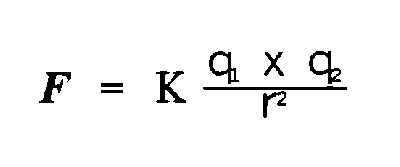
If two particles each have a charge of 3 coulombs, and the radius of a circle placed in between them is 2, then they will repulse each other with an initial force of 3*3k/2^2=9k/4=2.25k newtons, with the force deceasing as the radius of the circle between them increases. K here is a number derived using calculations involving the speed of light and various Greek letters, and will not be discussed here.
Electric potential is the electric potential energy of an object divided by the charge of the electric field the object is in. Electric potential is measured in volts. Mainly, we used electric potential to determine the current of an object using Ohm's Law.
Ohm's Law is a formula that states that the current that flows through an object equals the voltage of the object, divided by the object's resistance. It is usually represented as I=V/R, where R is usually replaced with the Greek letter omega.

This is an omega.
Ohm's Law allows us to determine how much current is flowing through an object, which allows us to determine whether an appliance, such as a hairdryer, will operate sub-optimally, at full power, or overload and malfunction.
There are two types of circuits: parallel and series.
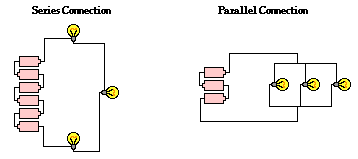
In the series connection, each object that draws power is connected in succession, while in the parallel circuit, each lightbulb is connected individually to the power source. In a series connection, each light must draw power from the same pool as the other two, which increases the resistance. This means that one must have a much higher electric potential to get full use from each light, as Ohm's Law states that as resistance increases, voltage must increase to give the same current. This essentially is adding traffic lights to the wire, slowing the current. The parallel circuit has multiple wires, allowing each light to light independently of the others. This decreases the resistance without decreasing the voltage, which Ohm's Law states will increase the current. This is like adding more lanes for cars on a road, allowing more cars to pass through the same road. Additionally, because all the bulbs in a series circuit are connected, if ones goes out, they all go out. This is not true for parallel circuits, where bulbs will remain independently lit.
There are several different types of charging an object. One way is friction charging. This involves rubbing an object against another object, causing one to take electrons from the other. This causes the giving object to become positive, and the taking object to become negative.

The balloon steals electrons from the woman's hair, causing it to become positively charged.
Another way is induction. An already-charged object is held close to an uncharged object, causing the uncharged object to polarize, meaning it becomes positive on one side and negative on the other. Capacitors charge and clouds create lightning this way.

Lightning, how induced charge between the earth and the clouds is dissipated.
We also covered electrical resistance. Resistance is measured in ohms. The symbol for an ohm is the omega, seen above. The resistance of an object is calculated by dividing the voltage of an object by the current flowing through the object. The result is the amount, in ohms, of resistance inherent in that object.
Monday, February 27, 2012
Unit reflection
This unit, we learned about multiple aspects of physics. The most important parts were the work-energy theorem, relationship between kinetic and potential energy, and the mechanics of work, kinetic energy, and potential energy.
We learned that work equals force times distance.

If a person pushes on a wall, he does no work because the wall does not move. If he carries a book, he does no work on the book because the force and distance vectors are perpendicular.
The work-energy theorem states that the change in energy equals work.

If we know the work and initial or final energy of an object, we can calculate the total energy of the object.
Kinetic and potential energy are inversely related. If one goes up, the other goes down by the same amount.

If an object's total energy is 10,000, and it's not moving, it has 10,000 joules of potential energy. If it has 5,000 joules of potential energy, it has 5,000 joules of kinetic energy.
An object's kinetic energy is calculated using this formula:
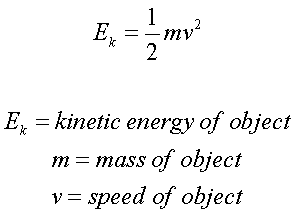
If an object's speed is doubled, its kinetic energy is quadrupled. If an object's speed is halved, it has one quarter of its original kinetic energy.
An object's potential energy is calculated using the following formula:

This also shows the work-energy theorem. If an object's mass and acceleration due to gravity are the same, but one has more potential energy, that one has more height. If one's potential energy is higher, but they have the same height and acceleration due to gravity, the one with more energy has more mass.
Sunday, February 26, 2012
Mousetrap car final blog
Unfortunately, when all was said and done, our mousetrap car was not victorious. However, we paid attention to how physics affected our car, so we can give an account of how what we've learned this year figured into our car.
The most obvious was Newton's laws of motion. The first law, that an object in motion would stay in motion in a straight line unless interfered with, was important for designing our steering. We knew that if our car turned, the steering was off. This allowed us to align our wheels as straight as possible. The second law, that acceleration is the net force divided by the mass, allowed us to figure out how to get a faster car. By reducing the mass and increasing the acceleration, we made our car have slightly more force than it did previously. The third law, that every action has an equal and opposite reaction, meant that we had to figure out how to direct the backwards force. The lever pushed the car forward, but the wheels pushed backwards against the floor. This propelled the car forward.
The friction of the floor against the wheels was both a boon and a hindrance. It pushed the car forward, but too much meant that we had a slow car, and we did not win. The friction used up energy from the mousetrap and acted on the car in the backwards direction.
We chose to use CDs for wheels, as they have a larger tangential velocity than a small wheel with the same rotational velocity. This allowed the car to move faster than with a small wheel. Originally, we planned to use 45s, but the difficulty in procuring them, plus the potential difficulty in securing them to the axle, caused us to scrap that plan. We also powered our car with the same plan. The tangential velocity of the skewer on the trap was higher than that of the trap itself, meaning more momentum and acceleration for the skewer.
The law of conservation of energy says that energy is never created or destroyed, just transferred. We used the skewer attached to the trap to impart a lot of energy to the wheels. Kinetic energy equals 1/2 mass times the velocity squared, so if the skewer had high velocity, the car would have lots of energy.
Our lever arm was a skewer. It was about 10 inches long. This, times the force of our car, meant that the torque was higher than the torque if we hadn't used a skewer. there, the lever arm would only be a few inches.
While the rotational velocity of our wheels was high, so was the rotational inertia. This meant a slow start, and therefore, low acceleration. we were unable to fully overcome this problem. Thus, our car did not move when it wax propelled. This was unfortunate.
We do not know how much work the car did. While we know how far it traveled, and we could determine the mass of the car, we don't know its acceleration. Thus we cannot determine the force, and therefore cannot determine work.
The general design of our car was the same as it was at the start, with some changes. Most notably, we replaced cotton balls in our plans with rolled-up paper towels. We also used a skewer instead of a pencil for a lever arm, and used a rubber band to connect the back axle and the end of the lever arm skewer. Mostly, though, the plan was unchanged.
We encountered a problem propelling our car. We could not get it to go, so we were unable to do a run. Thus, we were not victorious. This is still unfortunate.
If we were to do this project again, I would choose to develop a better way of propelling our car. Everything else worked fine. The wheels rolled, it went mostly straight, and the car stayed together. We just couldn't propel it.
Tuesday, February 21, 2012
Mousetrap car: Day 2
Today, followed a better formula. While our initial plan of replacing the CDs with plastic bottle caps was a failure due to the drill resistance of the caps, we used rolled-up paper towels and tape to position our CDs on the skewer axles. This worked better than any previous design. This design was able to roll 5 meters with us pushing it, so we decided to use it.
Friday, February 10, 2012
Mousetrap car: day 1
We were unable to progress far, due to a breakdown of communications. We succeeded in drilling holes for the eyelets, and inserting those. However, we were unable to progress further than that. We hope to do more work on the car over the weekend.
Mousetrap Blog
We are using the following items to construct our mousetrap cars:


Food skewers (axles)

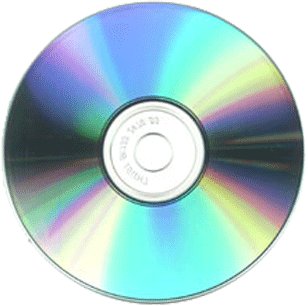
4 CDs (wheels)
Mousetrap (body and power source)

Eyelets (to hold the axles)
cotton balls (to keep the CDs in place)

A pen or pencil (to help power the car)
String
Process:
We will screw the bolts in. Then, we will put in the skewers. After that, we will glue on the pen to the mouse trap (to give the trap a higher rotational velocity). Then, we will put the CDs on the axles, and tie the string to the pen and rear axle. We will activate the trap, propelling the car forward.
Monday, January 30, 2012
Unit 5 Reflection
In this section, we studied centers of mass and gravity, angular momentum, torque, rotational velocity, and centripetal and centrifugal forces.
We first discussed centers of mass and gravity. We discussed how an object's centers of mass and gravity can be different, depending on the height of the object and the lever arm of each side. The torque, not the mass, of each side had to be in equilibrium to balance.
We discussed torque, which is the lever arm of an object, multiplied by its mass. If an object has a low mass, it can still have a higher torque than one with a large mass. To quote Archimedes, "give me a long enough lever, and a place to rest it on, and I can move the world."
Angular momentum is the momentum of an object moving in a circular path. The product of the mass multiplied by the radius multiplied by the velocity remains constant. This allows us to calculate how two of those figures change if one remains constant. For example, if the radius remains constant, the velocity and mass are inversely proportionate.
Rotational velocity is velocity in a circle. The magnitude of this velocity remains constant if no outside forces act on the object. However, the direction constantly changes. If it did not, the object would fly off in a path tangential to the circle.
Centripetal force is any force that pulls an object into the center of the circle. This may be tension, friction, or gravity. This keeps cans tied to strings going in circles, satellites in orbit, and cars in turns on the road.
Centrifugal force is not a real force. Instead, it is a term for an object's inertia causing the object to continue on its straight line path while being pulled into a circle. For more information, see the rotational velocity paragraph.
Wednesday, January 25, 2012
Torque And Center Of Mass Lab
Materials
1 meter stick
1 100-gram weight
A table (for use as a fulcrum)
Procedure
- We measured the meter stick's center of mass without the weight. We determined that it was at the 49.5 centimeter mark.
- We placed the 100-gram weight on the zero centimeter side of the meter stick and rebalanced it. The new center of mass was 29.4 centimeters.
- The distance between the old center of mass and the new center of mass was the lever arm for the side without the weight. This lever arm was 29.4 centimeters.
- The length from the new center of mass to the weight was the lever arm for that side. This was also 29.4 centimeters.
- Since the lever arms were the same, the forces must have also been balanced to balance the meter stick on the fulcrum. Thus, the masses were the same, as the acceleration due to gravity is constant.
- Since 50.5 centimeters of meter stick weighed 100 grams, then the meter stick must weigh 198.2 grams.
Subscribe to:
Comments (Atom)